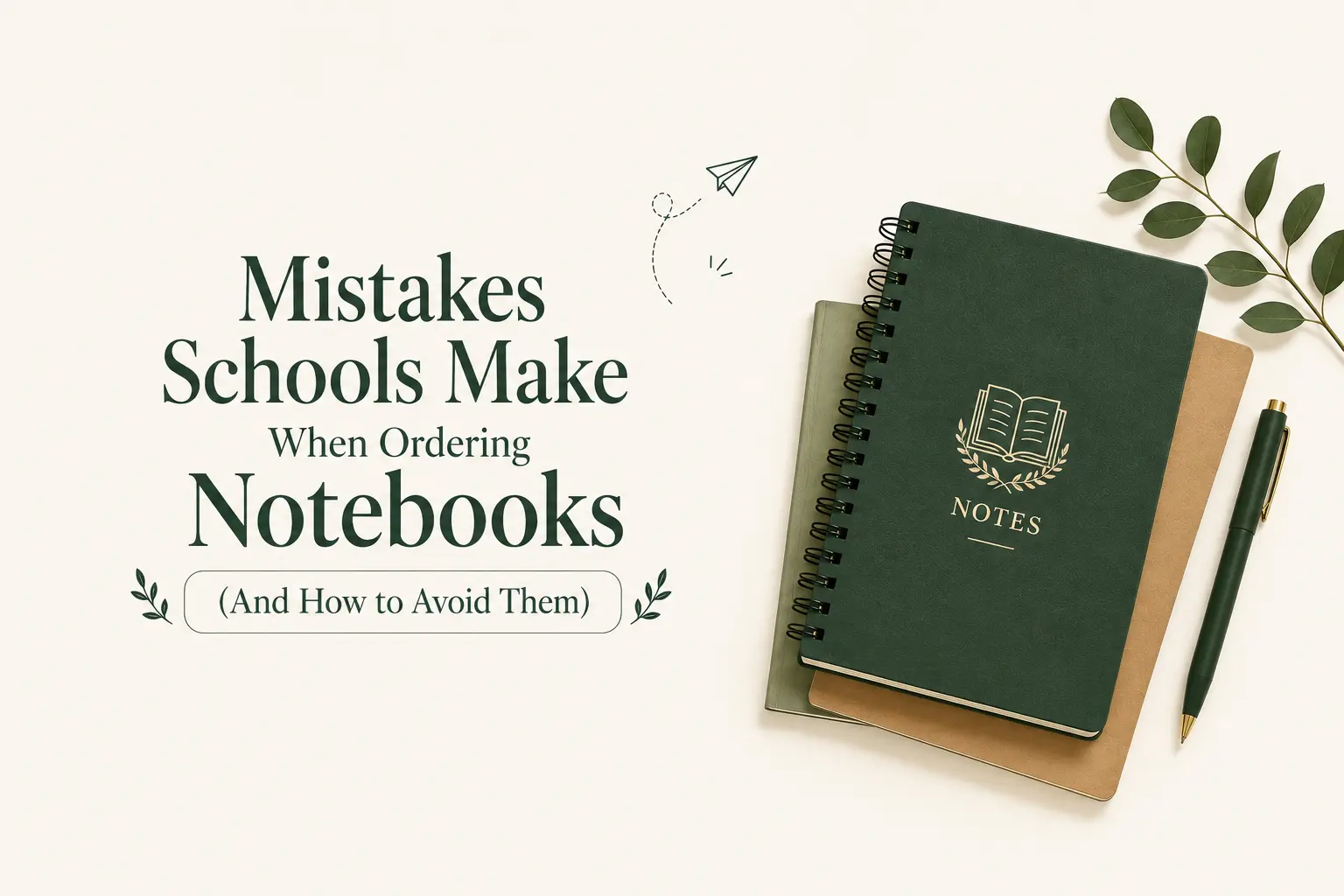
A school principal once told us that choosing notebooks for her students felt like the easiest item on her entire procurement list, right up until the day three hundred boxes arrived with pages that bled ink and covers that tore within a week. She had signed off on the cheapest quote in the file. It looked identical to every other quote on paper. It was not identical once it reached the classroom.
That story is not unusual. After years of working with schools, colleges and coaching institutes across Punjab and beyond, we have seen the same handful of mistakes repeat themselves, term after term, admission cycle after admission cycle. Notebooks seem like a simple, low-stakes purchase, but they touch almost every student, every day, for the entire academic year. Getting the order wrong is expensive in ways that go far beyond the invoice.
This article is written from the other side of the counter, from a manufacturer who has filled thousands of institutional notebook orders and has watched what separates a smooth, cost-effective procurement process from one that causes headaches long after the purchase order is signed. If you are responsible for buying school stationery, whether you are a principal, an administrator, a procurement officer or someone in the purchasing department of a college or coaching centre, this is meant to help you buy smarter, not just cheaper.
Mistake 1: Choosing a Supplier Based on Price Alone
This is the mistake we see most often, and it is the one that causes the most regret.
When you are managing a bulk notebook order for an entire school, budget pressure is real. Multiply the cost of a single notebook by a thousand students and small price differences start to look significant on paper. So it makes sense that price becomes the first filter, and sometimes the only one.
The problem is that notebook pricing hides a lot of variables. Two suppliers can quote the same price per notebook while using completely different paper GSM, different binding methods and different cover board thickness. The lowest quote is often the lowest because something has been cut, not because the manufacturer found a more efficient way to make the same product.
We always tell school buyers the same thing. Ask what is included in the price before comparing it to anything else. A notebook quoted at a slightly higher rate but using better paper and stronger binding will usually outlast a cheaper one by an entire term, which means you are not reordering mid-year to replace notebooks that fell apart. When you calculate cost per notebook per month of actual use, the cheaper option is rarely cheaper.
Mistake 2: Ignoring Notebook Paper Quality
Paper quality is the single most underestimated factor in a school notebook order, and it is also the hardest to judge from a quotation sheet alone.
Cheap paper causes ink to bleed through, especially with gel pens, which are what most students actually use now. It also tends to be rougher, which affects handwriting comfort over long study sessions, and it yellows faster, which matters if notebooks need to last an entire academic year without looking worn out by December.
As a manufacturer, we work with different GSM ranges depending on the intended use. A notebook meant for younger students who write with pencils has different requirements than a notebook meant for board exam students who write for hours at a stretch. Procurement officers do not need to become paper experts, but it helps to ask direct questions. What GSM is being used. Whether the paper is bleed resistant. Whether it has been tested with the pens students actually use, not just standard ballpoints.
If you want a deeper look at how paper quality affects long-term value, our article on The Complete Guide to Buying Notebooks for Schools and Colleges goes into this in more detail.
Mistake 3: Overlooking Binding Quality
Binding is the part of a notebook that nobody notices until it fails, and by then it has usually failed for every student who received that batch.
There are a few common binding types used in institutional notebooks, including stitched binding, spiral binding and perfect binding. Each has a place depending on notebook size and how heavily it will be used. A thick notebook with weak stitching will start shedding pages within weeks of daily use, particularly with younger students who are rougher on their belongings. A spiral notebook with a flimsy wire will bend out of shape after being carried in a school bag for a month.
We have had schools come to us after ordering notebooks elsewhere specifically because binding failed across an entire batch, and replacing notebooks mid-term for hundreds of students is far more disruptive and costly than getting the binding right the first time. When you are evaluating a bulk notebooks for schools order, ask to see how the binding is done and, more importantly, ask how it performs after repeated use, not just how it looks fresh out of the box.
Mistake 4: Ordering the Wrong Sizes or Page Counts
This mistake usually comes from treating notebook specifications as an afterthought rather than a decision that should match how each grade actually studies.
A single-line notebook meant for a Class 2 student learning to write does not serve the same purpose as a notebook for a Class 10 student preparing detailed subject notes. Page counts matter just as much. Order too few pages and students run out mid-term, leading to a scramble for replacements that do not match the rest of the class. Order too many and you are paying for paper that never gets used, term after term.
Good notebook procurement means mapping specifications to actual classroom use. Younger grades typically need wider ruling and slightly smaller formats that are easier for small hands to manage. Senior students benefit from higher page counts in subjects with heavier note-taking, like science or commerce. If your institution has never audited this properly, it is worth doing before your next order rather than defaulting to whatever was ordered last year.
Mistake 5: Not Asking for Notebook Samples Before Bulk Ordering
We understand why this step gets skipped. Procurement timelines are tight, and asking for samples feels like it adds a delay you do not have room for.
But committing to a bulk notebook order without physically checking a sample is one of the riskiest decisions a school can make. A photograph or a spec sheet cannot tell you how the paper feels under a gel pen, how the cover holds up when bent, or how the binding behaves after you flip through it repeatedly. Any manufacturer confident in their product should be willing to send samples without hesitation, and if a supplier is reluctant to do this, that reluctance tells you something on its own.
We recommend building sample review into your procurement calendar as a fixed step, not an optional one. It takes a few days, and those few days are far cheaper than discovering a quality problem after a thousand notebooks have already been distributed to students.
Mistake 6: Placing Orders Too Late in the Cycle
Every year, without fail, we get a wave of urgent calls in the weeks right before a new academic session starts. Schools that delayed their notebook procurement decision suddenly need thousands of units delivered in a fraction of the normal lead time.
Late ordering puts you at the mercy of whichever supplier has spare capacity, not necessarily the one with the best quality or the best fit for your institution. It also removes your ability to negotiate on price, since urgency shifts leverage entirely to the supplier's side. And if there is any delay in raw material availability or production scheduling, a late order leaves no buffer at all.
Notebook procurement should ideally start two to three months before the academic session begins, especially for larger institutions or anyone considering custom school notebooks with printed covers, which require additional design and approval time. If you are unsure how early is early enough for your specific order size, it is worth asking your manufacturer directly rather than guessing.
Mistake 7: Forgetting About Custom Branding Opportunities
Plain, generic notebooks get the job done, but schools that skip custom branding are missing a low-cost opportunity that pays off in ways beyond the classroom.
A notebook with your school's name, logo and colours printed on the cover does more than look professional. It reinforces institutional identity every single day a student opens it. It also makes notebooks harder to lose or mix up, which matters more than people expect, especially with younger students. For coaching institutes and colleges, branded notebooks double as a quiet, constant piece of marketing that reaches parents and students without feeling like marketing at all.
The misconception we run into most is that custom notebook printing is expensive or only viable for very large orders. In reality, custom school notebooks are far more accessible than most procurement teams assume, particularly when working directly with a manufacturer that has in-house printing capability rather than going through a middleman.
Mistake 8: Poor Communication With Suppliers
A surprising number of notebook order problems have nothing to do with paper or binding at all. They come down to communication breakdowns between the school and the supplier.
Specifications get discussed over a phone call and never confirmed in writing. Design approvals for custom covers get delayed because nobody is clear on who has final sign-off. Delivery expectations are assumed rather than confirmed, and then everyone is surprised when timelines do not match up.
The schools that consistently get this right treat their notebook manufacturer more like a project partner than a one-time vendor. They confirm every specification in writing, they set clear delivery milestones, and they designate one point of contact on their side so instructions do not get lost between departments. This sounds basic, but it prevents the vast majority of order disputes we see.
Mistake 9: Not Standardising Specifications Across Classes
It is common for a school to build up its notebook specifications gradually over the years, with different teachers or department heads requesting slightly different ruling styles, sizes or page counts without anyone reviewing the full picture.
The result is a procurement process with dozens of small variations to track, which increases the chance of ordering errors, makes reordering confusing, and often costs more in production simply because small custom variations reduce manufacturing efficiency compared to standardised runs.
Once a year, it is worth sitting down with a full list of every notebook specification currently in use across the institution and asking whether each variation is genuinely necessary. Standardising where you can, while keeping meaningful differences for genuinely different age groups or subjects, usually simplifies procurement and can improve your pricing as well.
Mistake 10: Ignoring Lead Times When Comparing Quotes
Two quotations can list identical prices and identical specifications, yet come with very different delivery timelines, and this detail is easy to miss when you are comparing offers side by side on price alone.
A shorter lead time sometimes comes at the cost of rushed production, which can affect quality control. A longer lead time from an established manufacturer might actually reflect a properly scheduled, quality-checked production run rather than a supplier being slow. Understanding the difference matters, and the only way to know is to ask directly what the lead time includes and why it is what it is.
We always encourage schools to build in a buffer beyond the quoted lead time as well. Transport delays, festival closures and unexpected demand spikes around the start of the academic session are common, and a tight timeline with no room for error puts your entire notebook distribution schedule at risk.
Mistake 11: Choosing a Supplier Instead of a Manufacturing Partner
This might be the most important mistake on this list, because it shapes every other decision.
A supplier sells you notebooks once. A manufacturing partner understands your institution's specifications, keeps a record of what has worked in past years, flags issues before they become problems, and grows with your school as class sizes or requirements change. When something needs adjusting, a manufacturing partner can adapt production directly, while a supplier working through a distribution chain often cannot.
Working directly with a notebook manufacturer in India rather than a reseller also tends to mean better pricing, more control over specifications, and far more accountability if something goes wrong, simply because there are fewer layers between your order and the factory floor.
If you want to understand what genuinely separates a good notebook from an average one before your next order, our article What Makes a Good School Notebook? 7 Things Most Buyers Don't Notice is worth a read.
Mistake 12: Overlooking the Student Experience
It is easy for procurement decisions to focus entirely on cost and logistics and forget that the actual end user is a child or a young adult who will use this notebook for months.
A notebook that is too heavy, has a cover that tears easily, or uses paper that makes handwriting uncomfortable affects a student's daily experience in small but real ways. Multiply that across an entire classroom and it becomes a factor in how students feel about their schoolwork, not just how the school's stationery budget looks on paper.
Schools that ask for feedback from teachers and even students after receiving a notebook batch tend to make better decisions the following year, because they are working from real classroom experience rather than assumptions made in a procurement meeting.
Mistake 13: Underestimating the Value of Consistency Year to Year
Switching manufacturers every year because of small price differences might seem like smart cost management, but it often costs more than it saves.
Every switch means relearning specifications, rebuilding trust, and risking quality inconsistency right when students and parents have gotten used to a particular notebook format. Consistency also matters for institutional identity, especially if notebooks carry your school's branding. A school that has worked with the same reliable notebook manufacturer for several years usually has smoother procurement, better negotiated pricing over time, and fewer surprises than one that restarts the relationship annually.
Getting Notebook Procurement Right, Term After Term
None of these mistakes happen because school administrators are careless. They happen because notebook procurement looks simple on the surface, and the details that actually matter, paper GSM, binding type, lead times, specification consistency, are not things most buyers are trained to evaluate. That is not a failure on the school's part. It is simply a gap that the right manufacturing partner should help close.
The practical fix is straightforward even if it takes a bit more effort upfront. Ask more questions before comparing prices. Request samples before committing to a bulk order. Standardise your specifications across classes where it makes sense. Build in realistic lead times. And look for a manufacturing partner who treats your institution's notebooks as a long-term relationship rather than a single transaction.
At Seth Faqir Chand Karwa & Co., we manufacture custom notebooks using a fully automatic notebook manufacturing line based in Ludhiana, and we also offer custom notebook printing for schools, colleges and coaching institutes that want their branding on every cover. If any of the questions raised in this article feel relevant to your next order, we are happy to talk through your specifications before you commit to anything.
Frequently Asked Questions
1. How many notebooks should a school order for an academic year?
The quantity depends on the number of students, subjects, classes, notebook page counts and how often teachers require students to start a new notebook.
A practical way to calculate the requirement is to work out the number of notebooks required per student for each subject and then multiply that figure by the number of students in each class. For example, a school may require separate notebooks for English, mathematics, science, social studies and other subjects, with different page counts depending on the class.
It is also sensible to keep a small additional quantity for new admissions, damaged notebooks, lost notebooks and students who require replacement books during the year. Keeping this buffer in the original procurement is usually easier than arranging a small urgent order later.
2. What information is required to get an accurate quotation for bulk notebooks?
A manufacturer will need the basic notebook specifications before giving a meaningful quotation. These normally include the size, page count, ruling, paper GSM, binding, cover specification and quantity.
If the notebooks are customised, the requirement should also mention the school logo, cover printing, colours, subject names or any other information that needs to appear on the notebook.
For schools ordering different notebooks for different classes, it is better to provide the requirement in a simple class-wise list. This allows the manufacturer to quote each specification correctly instead of giving one price based on assumptions.
3. Which notebook binding lasts the longest for daily school use?
There is no single binding that is best for every notebook because the suitable binding depends on the number of pages and how the notebook will be used.
For regular school exercise books, stapled or stitched construction can work well for thinner notebooks. Stitched binding is particularly useful when stronger page retention is required in thicker notebooks.
Spiral or wire binding is useful when students need the notebook to open completely flat or fold backwards, but the quality of the wire and punching also matters. Perfect binding gives a clean book-like appearance and can work well for certain formats, although it may not be the first choice for notebooks that are opened and handled heavily throughout the year.
4. Can schools print their own logo and branding on notebooks?
Yes. Schools can have notebooks manufactured with their logo, school name, colours, photographs, school motto, contact details and other branding.
The cover can also be different for different classes or subjects. For example, a school may use separate covers for mathematics, science, English and other subjects while maintaining the same overall school branding.
The usual process is to provide the logo or artwork, finalise the notebook specifications, approve the cover design and then proceed with production. Schools should approve the final artwork carefully before printing because changes after printing has started can be difficult and expensive to make.
5. How early should schools place their notebook orders?
Schools should ideally start planning their notebook requirement two to three months before the new academic session, particularly when the notebooks are customised.
The time required is not only for manufacturing. Schools may need time to finalise quantities, compare quotations, approve samples, provide artwork, make changes to the design and confirm the final specifications before production begins.
Larger orders should be planned earlier, especially when several notebook sizes, rulings, page counts or cover designs are required. Ordering early also gives some flexibility if there are delays in artwork approval, production or transportation.
6. What is the minimum order quantity for custom notebook printing?
The minimum quantity depends on the manufacturer, notebook specification and number of different designs required.
A single school may be able to order customised notebooks if the quantity is sufficient for efficient production, particularly when the same cover design and notebook specification are used across a large number of books.
If a school requires many different covers, sizes or rulings in small quantities, the minimum quantity for each individual specification may become important. It is therefore better to provide the complete quantity requirement rather than asking only for a general custom notebook MOQ.
7. How do I choose a reliable notebook manufacturer in India?
Price should not be the only factor when selecting a manufacturer for an annual school requirement. Ask whether the supplier actually manufactures the notebooks, what production capacity they have, whether they can provide samples and how they handle customised institutional orders.
It is also worth checking the paper specification, page count, ruling, binding, cover quality and expected delivery schedule before comparing prices.
A manufacturer who clearly specifies what is included in the quotation makes it much easier to compare suppliers. If possible, schools should also look at samples from previous production and ask about experience with similar institutional quantities.
8. Should schools ask for notebook samples before placing a bulk order?
Yes. A sample allows the procurement team to check things that cannot be judged properly from a quotation.
The school can physically check the paper feel, GSM, opacity, writing performance, ruling, page count, cover quality and binding before approving the order. This is particularly important when thousands of notebooks are being purchased.
If the notebooks are customised, the school should also check the cover printing, logo placement, colours and any text appearing on the pages. Approving a sample before mass production can prevent a relatively small specification mistake from affecting the entire order.
9. Which notebook type is best suited for younger students?
Younger students generally benefit from notebooks that are easy to handle, have suitable ruling and are not unnecessarily heavy.
For early writing practice, wider ruling such as four-line formats can be more appropriate than standard single-line ruling. Smaller or lighter notebooks may also be easier for younger children to carry between classes.
The cover and binding should be reasonably durable because younger students may handle their notebooks more roughly. Schools should also consider whether the notebook will be used for a particular subject before deciding its page count and ruling.
10. What paper quality is best for school notebooks?
Good notebook paper should provide a smooth writing surface, reasonable opacity and consistent thickness throughout the notebook. It should also work well with the writing instruments students actually use.
For school notebooks, the paper should ideally have minimal ink show-through, good formation and a surface that does not make writing uncomfortable. GSM is important, but it should not be the only specification used to judge paper quality.
For example, a school comparing 60 GSM and 70 GSM paper should look at the actual samples and test them with the pens commonly used by students. This gives a much better indication of suitability than comparing GSM numbers alone.
11. What is the difference between a notebook supplier and a notebook manufacturer?
A supplier may purchase finished notebooks from another manufacturer and resell them to the school. A manufacturer produces the notebooks directly and can generally have greater control over the paper, ruling, printing, binding and other production specifications.
For large institutional orders, dealing directly with the manufacturer can also make customisation easier. Schools can discuss changes to the size, page count, GSM, ruling, cover design or binding directly with the production team rather than passing requirements through another party.
The distinction is particularly important when a school has a quality or delivery issue because the manufacturer is directly responsible for the production of the notebooks.
12. How can schools ensure consistency across large notebook orders?
The specifications should be finalised and recorded clearly before production begins. This should include the exact size, page count, paper GSM, ruling, cover design, binding and printing requirements for each notebook type.
Schools ordering multiple notebook varieties should maintain a simple specification sheet showing the requirement for each class or subject. This reduces confusion when several notebooks are being produced at the same time.
For repeat annual orders, continuing with the same specifications and manufacturer can also help maintain consistency. Schools can compare the new production against an approved sample or previous year's notebook before accepting a large shipment.
13. What are common signs that a notebook order may have quality problems?
One warning sign is when a quotation does not clearly mention basic specifications such as paper GSM, page count, binding or cover material. Without these details, it becomes difficult to compare one quotation with another.
Schools should also be cautious if a supplier refuses to provide a sample, cannot give a clear production timeline or gives a price that is substantially lower than other quotations for the same specifications.
A low price by itself does not mean the quality will be poor, but the school should find out where the difference comes from. The paper, page count, cover, binding or other specification may simply be different from what other suppliers have quoted.
14. Is it more cost effective to order notebooks directly from a manufacturer?
For large quantities, buying directly from a manufacturer can often provide better pricing because the school is purchasing closer to the source of production.
The advantage is not limited to price. Direct dealing also gives the school greater control over specifications and allows changes to be discussed directly with the manufacturer. This can be useful when a school wants a particular paper GSM, ruling, page count, cover design or binding.
However, schools should compare quotations on an identical specification. A lower price may simply reflect a lower GSM, fewer pages, a different cover or a different binding method.
15. What should be included in a notebook procurement checklist for schools?
A school should finalise the requirement before requesting quotations. The checklist should cover the number of students, notebooks required per student, class-wise quantities, notebook size, ruling, page count, paper GSM, binding, cover specification and custom printing requirements.
It should also include the required delivery date, delivery location, sample approval, packaging requirements and any additional quantity required as a replacement buffer.
For schools with several grades, keeping all these details in one specification sheet makes procurement much easier. It allows the school to compare quotations properly and gives the manufacturer a clear production requirement instead of relying on verbal instructions.
16. Can schools order different notebook specifications from the same manufacturer?
Yes. A school can order different sizes, page counts, rulings and covers according to the requirements of different classes and subjects.
For example, junior classes may require four-line notebooks, while senior classes may require single-line or square-ruled notebooks. Different subjects can also have different page counts depending on how much writing students are expected to do.
The important point is to provide the manufacturer with the complete requirement at the beginning. This allows the quantities for each specification to be checked against the applicable minimum production quantities and helps the manufacturer plan the complete order together.
school notebooks
school notebook manufacturer
bulk notebook order
bulk notebooks for schools
institutional notebook supplier
custom school notebooks
college notebooks
notebook manufacturer in Punjab
notebook supplier
educational notebooks
school stationery
bulk notebook manufacturer
custom notebook printing
school notebook printing
notebook procurement
institutional stationery
Related Articles
Need Bulk Paper?
We supply A4 copier paper at wholesale prices across North India.
Get a Quote WhatsApp UsRecent Articles