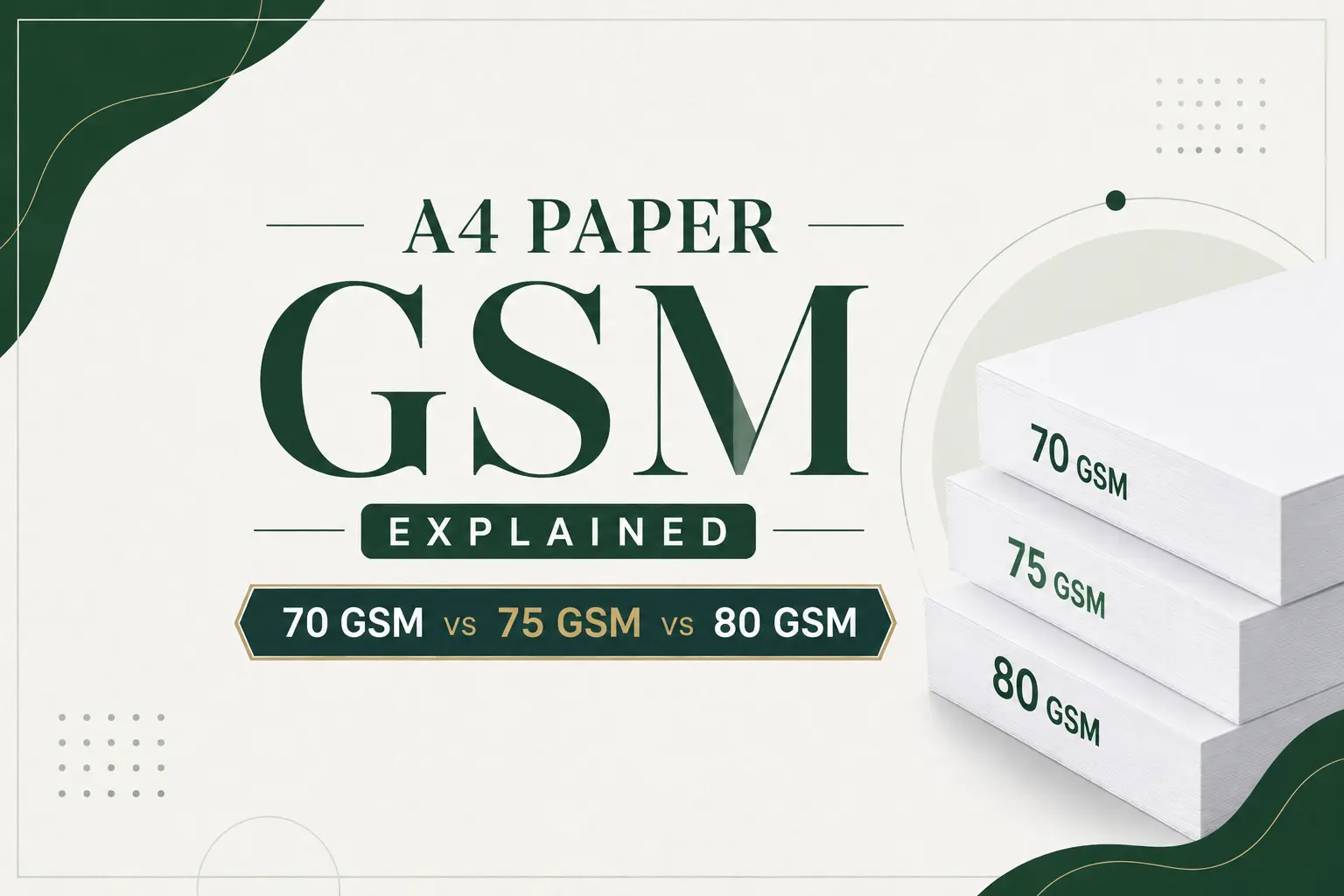
When buying A4 copier paper, you will commonly find 70 GSM, 75 GSM and 80 GSM options. While the difference may seem small, GSM affects the weight, feel and suitability of paper for different printing applications.
But does higher GSM mean better paper? And which GSM is best for everyday printing? Here’s a simple guide to understanding 70 GSM vs 75 GSM vs 80 GSM A4 paper.
What Does GSM Mean in Paper?
GSM stands for Grams per Square Metre (g/m²) and refers to the weight of paper per square metre.
Simply put:
- 70 GSM = 70 grams per square metre
- 75 GSM = 75 grams per square metre
- 80 GSM = 80 grams per square metre
A higher GSM means more paper mass per unit area. However, higher GSM does not automatically mean better quality.
The quality and performance of copier paper also depend on factors such as opacity, brightness, smoothness, stiffness, moisture and runnability.
70 GSM vs 75 GSM vs 80 GSM A4 Paper
| Feature | 70 GSM | 75 GSM | 80 GSM |
|---|---|---|---|
| Weight | Lightweight | Medium | Heavier |
| Feel | Light | Balanced | More substantial |
| High-volume printing | Excellent | Excellent | Good |
| Everyday office use | Good | Excellent | Excellent |
| Double-sided printing | Suitable* | Good* | Very Good* |
| Print show-through | Generally higher | Moderate | Generally lower |
| Best for | Bulk & routine printing | Everyday office use | Professional documents |
*Actual performance depends on the quality and opacity of the individual paper.
What Is 70 GSM A4 Paper?
70 GSM A4 paper is lightweight and commonly used for high-volume printing and photocopying.
It is particularly suitable for businesses, offices, schools and institutions that consume large quantities of paper for routine documents, invoices, drafts and records.
Because it contains less paper mass per sheet than 75 or 80 GSM, it can be an economical choice for bulk printing. A good-quality 70 GSM copier paper can still provide excellent print quality and reliable printer performance.
What Is 75 GSM A4 Paper?
75 GSM A4 paper provides a balance between lightweight 70 GSM and heavier 80 GSM paper.
It is a versatile option for everyday office printing, including reports, invoices, correspondence, photocopying and general documentation.
For organisations looking for a combination of economy, paper feel and everyday printing performance, 75 GSM is often a practical choice.
What Is 80 GSM A4 Paper?
80 GSM A4 paper has a more substantial feel and is commonly preferred for professional documents.
It is suitable for business letters, reports, presentations, proposals, quotations and documents that may be printed on both sides.
The additional grammage can also contribute to reduced show-through, although the actual opacity depends on the construction and quality of the paper.
How Much Does an A4 Sheet Actually Weigh?
A standard A4 sheet measures 210 × 297 mm. Based on this size, the approximate paper weight is:
| Paper | Weight per A4 Sheet | Weight of 500 Sheets* |
|---|---|---|
| 70 GSM | 4.37 g | 2.18 kg |
| 75 GSM | 4.68 g | 2.34 kg |
| 80 GSM | 4.99 g | 2.49 kg |
*Approximate paper weight excluding packaging.
An 80 GSM sheet therefore contains about 14.3% more paper mass than a 70 GSM sheet of the same size.
For one ream, the difference may not seem significant. For businesses purchasing hundreds or thousands of reams, however, the difference in overall paper consumption and weight becomes much more noticeable.
Does Higher GSM Mean Better Paper Quality?
No. GSM measures paper weight, not overall paper quality.
When comparing A4 copier paper, you should also consider:
Opacity: Higher opacity helps reduce printing from showing through the opposite side, particularly during double-sided printing.
Brightness and whiteness: These influence the appearance of the sheet and contrast of printed text and graphics.
Smoothness: A good surface helps produce clean printing and consistent toner or ink reproduction.
Stiffness: Appropriate stiffness helps paper travel reliably through printers and photocopiers.
Runnability: Good copier paper should feed consistently through printing equipment with minimal curling, misfeeds or excessive paper dust.
A high-quality 70 GSM paper can therefore perform better than a poorly manufactured 80 GSM paper.
Which GSM Is Best for Double-Sided Printing?
For double-sided or duplex printing, opacity is particularly important.
Generally, 70 GSM works well for economical everyday printing, 75 GSM provides a good balance for regular office duplex printing, while 80 GSM is often preferred for reports and professional documents where reducing show-through is important.
However, opacity and manufacturing quality should always be considered alongside GSM.
Does 70 GSM Paper Cause Printer Jams?
Not necessarily.
Printer jams can be caused by moisture, paper curl, poor cutting, improper storage, incorrect loading, paper stiffness or the condition of the printer itself.
A good-quality 70 GSM copier paper designed for modern printers can provide reliable performance. Always ensure that the paper GSM falls within the specifications recommended by your printer manufacturer.
Is GSM the Same as Paper Thickness?
No. GSM and thickness are different measurements.
GSM measures the mass of paper per square metre, while paper thickness or caliper is generally measured in microns.
Two different 80 GSM papers can therefore have different thicknesses depending on their fibre composition, density and manufacturing process.
So, Which A4 Paper GSM Should You Choose?
The best choice depends on how the paper will be used.
Choose 70 GSM for economical, high-volume printing, photocopying and routine documents.
Choose 75 GSM for balanced everyday office printing and general business use.
Choose 80 GSM for reports, presentations, correspondence and professional documents where a more substantial paper feel is preferred.
Ultimately, there is no universal winner in the 70 GSM vs 75 GSM vs 80 GSM comparison. GSM is important, but opacity, smoothness, stiffness, brightness, runnability and overall manufacturing quality should also be considered when choosing A4 copier paper.
About Seth Faqir Chand Karwa & Co.
Frequently Asked Questions
1. Is 80 GSM A4 paper actually better than 70 GSM paper?
Not automatically. GSM measures the weight of the paper, not its overall quality. An 80 GSM sheet can feel heavier and may provide better opacity and a more substantial feel, but a well-manufactured 70 GSM paper can deliver better smoothness, formation, runnability and print performance than a poor-quality 80 GSM sheet.
For high-volume office printing, the difference is more noticeable in paper consumption, handling and cost per ream than simply in how “premium” the paper feels. If the document is mostly internal communication, drafts, invoices or routine photocopying, 70 GSM may be sufficient. For documents printed on both sides, reports or material where show-through is a concern, 75 or 80 GSM may be more appropriate.
2. When should I choose 70 GSM instead of 75 or 80 GSM A4 paper?
70 GSM is particularly useful when the priority is high-volume printing at a controlled paper cost. Offices, institutions, schools, banks and businesses that consume large quantities of A4 paper can save on paper consumption when 70 GSM performs reliably in their printers and copiers.
However, choosing 70 GSM purely because it is cheaper can be counterproductive if the paper has poor formation, excessive dust, curling or inconsistent thickness. A cheaper ream that causes more misfeeds, jams or poor-quality prints can increase the effective cost of printing.
The practical question is therefore not simply “What is the cheapest GSM?” but “Which paper gives reliable performance at the required volume and document quality?”
3. Is 75 GSM A4 paper the best compromise between 70 GSM and 80 GSM?
For many general office applications, 75 GSM can be a practical middle ground. It provides slightly more substance and potentially better opacity than 70 GSM without moving all the way to the weight and cost of 80 GSM.
This makes 75 GSM worth considering when documents are frequently printed double-sided, distributed externally, or handled repeatedly. However, GSM alone should not be used to assume that every 75 GSM paper will outperform every 70 GSM or 80 GSM paper. Brightness, opacity, smoothness, formation, moisture control and machine compatibility can materially affect the actual result.
4. Why does some 70 GSM A4 paper print better than some 80 GSM paper?
Because GSM is only one specification. Two papers with different grammages can have very different manufacturing characteristics.
A good copier paper needs to maintain consistent sheet formation, dimensional stability, surface properties and moisture balance. These characteristics influence how the sheet travels through a high-speed copier or printer, how toner or ink is deposited, and how the sheet behaves during duplex printing.
This is why comparing copier paper purely on 70 GSM vs 80 GSM can be misleading. A buyer should also consider brightness, opacity, smoothness, stiffness, moisture, dust generation and the paper's intended machine application.
5. Does higher GSM reduce ink or toner consumption?
Not necessarily. Moving from 70 GSM to 75 or 80 GSM does not automatically mean that a printer will use less toner or ink.
Toner and ink consumption are primarily influenced by the printing technology, coverage, printer settings and the characteristics of the paper surface. A smoother, more suitable paper may produce cleaner text and images, but that should not be confused with a direct GSM-based reduction in toner consumption.
For businesses purchasing paper in bulk, it is more useful to evaluate print quality, reject rates, machine performance and total cost per printed document rather than assuming that higher GSM will reduce consumable costs.
6. Is 70 GSM A4 paper suitable for double-sided printing?
It can be, but the important consideration is opacity rather than GSM alone.
When printing on both sides, excessive show-through can make text from the reverse side distracting and reduce document readability. A well-formed 70 GSM sheet with good opacity can therefore perform better for duplex printing than a poorly manufactured heavier sheet.
For reports, presentations, notices and documents where both sides are heavily printed, 75 or 80 GSM may provide a more comfortable reading experience. For routine office documents with lighter print coverage, quality 70 GSM paper may still be perfectly adequate.
7. Why does A4 paper curl, jam or stick together in a printer even when the GSM is correct?
A paper's grammage does not guarantee reliable machine performance. Curling, misfeeds and multiple-sheet feeding can be influenced by moisture content, storage conditions, dimensional stability, cutting accuracy and the paper's interaction with the printer's feeding system.
For example, paper stored in a humid environment can absorb moisture and behave differently from the same paper stored correctly. Opening reams and leaving them exposed for long periods can also affect performance.
This is particularly important for offices and institutions purchasing A4 paper in bulk. Correct GSM is only the starting point; paper quality and storage conditions both affect actual runnability.
8. Does 80 GSM A4 paper make documents look more professional?
Sometimes, but not simply because the number is higher. 80 GSM generally gives a sheet a heavier and more substantial feel, which can be useful for documents that are handled frequently or presented externally.
For everyday internal printing, however, the difference may provide little practical benefit. If the document's appearance depends mainly on clear text, good contrast and minimal show-through, brightness, opacity, surface quality and print performance may matter more than moving from 75 GSM to 80 GSM.
For this reason, companies should select GSM based on the document's purpose rather than assuming that the highest GSM is always the most professional option.
9. How much does choosing 70 GSM instead of 80 GSM A4 paper actually matter for a large office?
The difference becomes significant when paper consumption is high. Since GSM represents the weight of the paper per square metre, moving from 80 GSM to 70 GSM reduces the amount of paper fibre used per unit area.
For an organisation consuming hundreds or thousands of reams, this can affect purchase cost, paper weight handled and storage requirements. However, the saving only makes sense if the lower-GSM paper provides the required opacity and machine performance.
For bulk buyers, the better comparison is therefore not simply the price per ream, but the overall cost and performance at the organisation's actual printing volume.
10. What should I check besides GSM when buying A4 copier paper?
GSM should be considered alongside several other specifications. Depending on the application, buyers should look at brightness, opacity, smoothness, stiffness, formation, moisture stability, dust level and printer/copier compatibility.
For high-volume institutional or commercial purchasing, consistency between batches is also important. A paper that performs well in a machine during one purchase but produces frequent jams or poor duplex results in another batch can create operational problems.
This is why experienced paper buyers should evaluate A4 paper as a combination of sheet properties and machine performance, rather than selecting it based on GSM alone.
11. Is 70 GSM paper cheaper because it is lower quality?
No. Lower GSM does not inherently mean lower quality. It simply means the paper has a lower basis weight.
A 70 GSM paper can be specifically engineered for high-volume copier and printer applications and can provide excellent performance. Conversely, an 80 GSM paper can still have problems if its manufacturing or storage quality is poor.
The more useful distinction is between paper weight and paper quality. GSM tells you how much the paper weighs; it does not independently tell you how smoothly it runs through a machine, how opaque it is or how cleanly it prints.
12. What is the best A4 GSM for schools, offices and institutions?
There is no universal answer because the ideal GSM depends on the type and volume of printing.
For high-volume routine printing, 70 GSM can be an economical choice when the paper provides reliable machine performance. 75 GSM can work well when a balance between economy, opacity and sheet feel is required. 80 GSM is more suitable when greater substance, opacity or a more substantial document feel is valuable.
For institutional buyers, the decision should therefore consider monthly consumption, printer/copier fleet, duplex printing requirements, document type, storage conditions and budget rather than selecting a GSM purely because it is commonly used.
GSM
A4 Paper
Paper Weight
Buying Guide
Related Articles
Need Bulk Paper?
We supply A4 copier paper at wholesale prices across North India.
Get a Quote WhatsApp UsRecent Articles