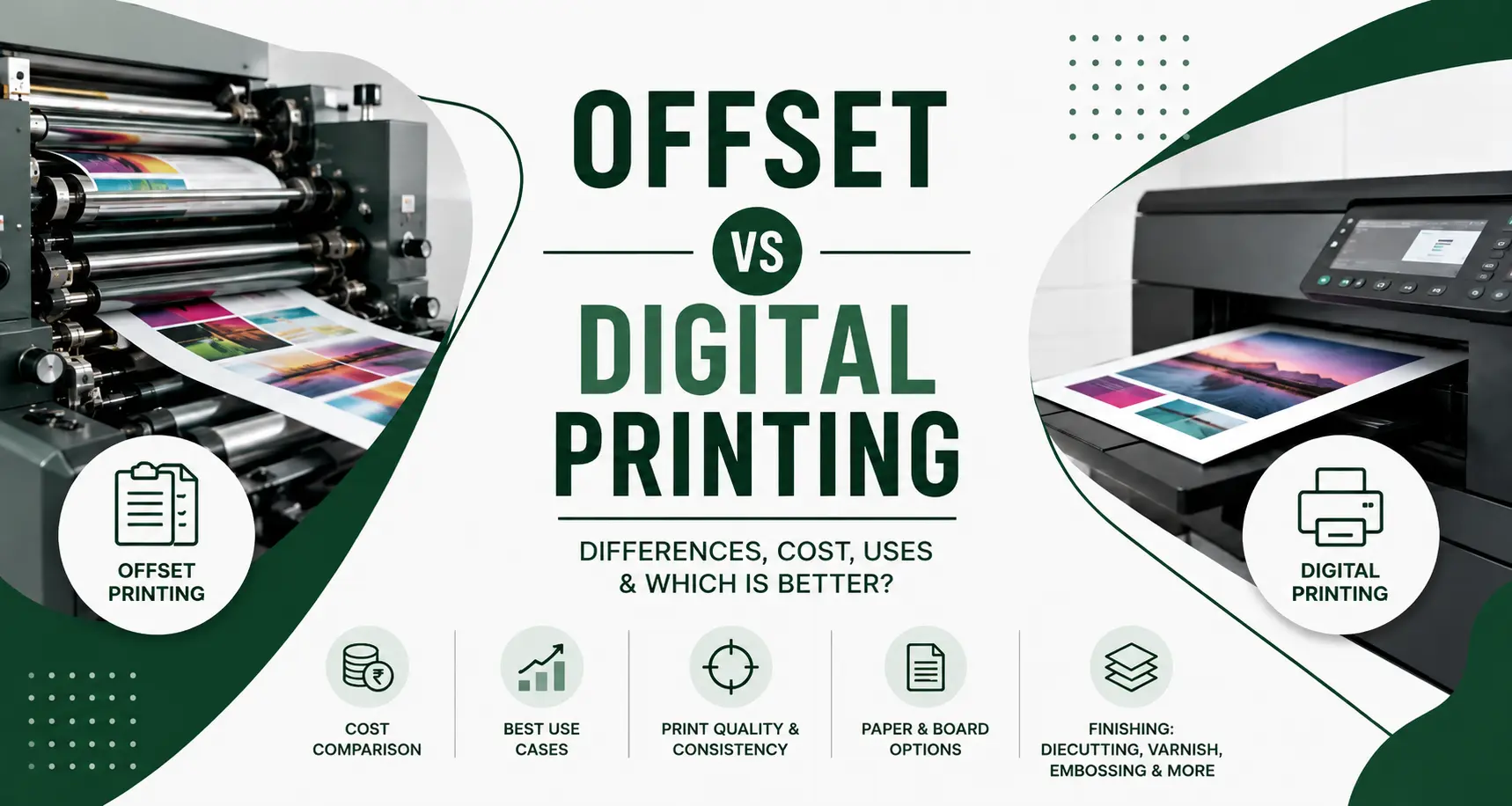
Choosing between offset printing and digital printing depends on what you are printing, how many copies you need, the material being used, finishing requirements and your budget.
Digital printing is generally ideal for short runs, prototypes and personalised printing, while offset printing is widely used for bulk commercial printing and packaging where consistent quality, production speed and cost efficiency at scale are important.
Here is a complete comparison of offset vs digital printing to help you choose the right process for your project.
What Is Offset Printing?
Offset printing is a commercial printing process in which an image is transferred from a printing plate onto a rubber blanket and then onto the paper or board.
The process requires plates and initial machine setup. However, once the press is running, it can produce large quantities at high speeds with excellent consistency.
Offset printing is commonly used for:
- Product packaging and folding cartons
- Food and bakery boxes
- FMCG packaging
- Brochures and catalogues
- Notebook and book covers
- Posters and promotional material
- Corporate stationery
- Labels and inserts
- Other high-volume commercial printing
What Is Digital Printing?
Digital printing transfers an image directly from a digital file to the printing equipment without requiring conventional printing plates.
Because there is less initial setup, digital printing is particularly useful for small quantities and quick-turnaround jobs.
It is commonly used for:
- Short print runs
- Samples and prototypes
- Personalised printing
- Business cards
- Short-run brochures and flyers
- Variable-data printing
- Jobs containing unique names, QR codes or serial numbers
Offset Printing vs Digital Printing: Key Differences
| Feature | Offset Printing | Digital Printing |
|---|---|---|
| Best for | Medium & large runs | Short runs |
| Initial setup | Higher | Low |
| Printing plates | Required | Not conventionally required |
| Cost at high quantities | Generally lower per unit | Generally higher per unit |
| Colour consistency | Excellent across long runs | Very good |
| Production speed | Very high once set up | Fast for smaller jobs |
| Variable data | Limited | Excellent |
| Personalisation | Limited | Excellent |
| Paper & board options | Extensive | Equipment dependent |
| Packaging | Excellent for commercial runs | Useful for short runs/prototypes |
| Finishing options | Extensive | Process/equipment dependent |
| Artwork changes | New setup/plates may be required | Easier between runs |
Which Printing Method Is Better for Packaging?
For commercial packaging in larger quantities, offset printing is generally the preferred process.
Packaging often requires much more than simply printing an image.
A folding carton, for example, may go through several stages:
Printing → Coating/Lamination → Die Cutting & Creasing → Embossing or Special Finishing → Folding/Conversion
Offset printing integrates particularly well with these production processes and can be used across a wide variety of paper and board specifications.
Common applications include:
- Bakery and confectionery boxes
- Sweet boxes
- Food packaging
- FMCG packaging
- Pharmaceutical cartons
- Cosmetic packaging
- Electrical product packaging
- Stationery boxes
- Mono cartons
- Branded retail packaging
Digital printing can still be valuable for packaging samples, prototypes and very short production runs.
Paper and Board Options for Offset Printing
One major advantage of offset printing is its ability to work with a broad range of substrates.
At Seth Faqir Chand Karwa & Co., our offset printing capabilities include:
| Material | GSM Range | Typical Applications |
|---|---|---|
| Paper | 60–120 GSM | Inserts, stationery & commercial printing |
| Art Paper | 80–170 GSM | Brochures, catalogues & promotional printing |
| Art Card | 200–350 GSM | Premium printed material & packaging |
| Duplex Board | 200–400 GSM | Folding cartons & product packaging |
The right material depends on the required strength, appearance, stiffness, print finish and end use of the product.
Die Cutting, Embossing, Varnishing & Other Finishing
Printing is often only the first stage of producing premium packaging.
Die Cutting
Die cutting uses a custom-made die to cut the printed paper or board into the required shape. Creasing lines can also be created so the board can later be folded into a carton.
Embossing
Embossing creates raised elements on the printed surface. It is commonly used to highlight logos, brand names, patterns or selected design elements and give packaging a more tactile appearance.
Varnishing
Varnish is a coating applied over printed material to improve its appearance and provide additional surface protection.
Lamination
Lamination applies a thin film over the printed surface. It can improve durability while also changing the visual and tactile appearance of the packaging.
UV & Spot UV
UV coating can create a high-gloss surface, while Spot UV applies the effect selectively to particular areas such as a logo, image or product name.
The appropriate finishing combination depends on the design, material, application, desired appearance and budget.
Our Heidelberg Offset Printing Facility in Ludhiana
Seth Faqir Chand Karwa & Co. operates an in-house Heidelberg Speedmaster 5-colour offset printing press at our manufacturing facility in Ludhiana, Punjab.
Our facility is equipped for commercial printing and packaging production, supported by capabilities including die cutting, embossing, varnishing, and lamination.
Depending on the substrate and job specifications, our offset press can produce approximately 25,000–30,000 sheets during a 12-hour production period.
This integrated setup allows us to cater to commercial requirements across food and bakery packaging, FMCG packaging, stationery, folding cartons, printed paper products and other commercial applications.
Offset or Digital Printing: Which Should You Choose?
Choose digital printing when you need a small quantity, fast setup, prototypes, personalised printing or variable information.
Choose offset printing when you require larger quantities, consistent colour reproduction, commercial packaging, extensive paper and board options or specialised finishing.
The right choice ultimately depends on five things:
Quantity + Material + Print Requirements + Finishing + Budget
Instead of choosing a printing process first, start with the requirements of the final product.
Frequently Asked Questions
1. Is offset printing cheaper than digital printing?
For very small quantities, digital printing is generally more economical because it requires less initial setup. For larger quantities, offset printing can become more economical per unit because the plate and setup costs are distributed across the entire production run.
2. At what quantity does offset printing become cheaper than digital printing?
There is no universal break-even quantity. It depends on the sheet size, number of colours, substrate, artwork, finishing requirements and printing equipment. A printer should compare the specifications of the complete job before recommending offset or digital printing.
3. Which is better for packaging: offset or digital printing?
Offset printing is generally preferred for medium and large commercial packaging runs, particularly when consistent colours, paperboard printing and post-print finishing are required. Digital printing can be particularly useful for prototypes, samples and short packaging runs.
4. What is the minimum quantity for offset printing?
There is no fixed industry-wide MOQ. Since offset printing requires plates and machine setup, extremely small quantities are usually less economical. The practical minimum depends on the size, substrate, number of colours and finishing requirements of the job.
5. Which printing method gives better print quality?
Both technologies can produce excellent results. Offset printing is particularly valued for fine detail and consistent colour reproduction across long production runs, while modern digital printing can deliver excellent quality for shorter runs.
6. What materials can be used for offset printing?
Offset printing can be performed on various coated and uncoated papers and paperboards. Depending on the equipment and application, these can include writing and printing paper, art paper, art card and duplex board in different GSM ranges.
7. Can offset printing be done on duplex board?
Yes. Offset printing is widely used for duplex-board packaging and folding cartons. After printing, the board can undergo processes such as varnishing, lamination, die cutting, creasing and embossing depending on the packaging design.
8. What is die cutting in packaging?
Die cutting is the process of cutting printed paper or board into a specific shape using a custom die. In folding-carton production, the die can also create crease lines that allow the printed board to be folded into the final box.
9. What is embossing in printing and packaging?
Embossing creates a raised design or texture on paper or board. It is commonly used to highlight logos, lettering and design elements on premium packaging, invitations, covers and other printed products.
10. What is the difference between varnish, lamination and UV coating?
Varnish is a liquid coating applied over printed material, while lamination involves bonding a thin film to the surface. UV coating produces a cured glossy surface, while Spot UV can highlight selected portions of a design. The appropriate option depends on the desired appearance, protection and application.
11. Can offset printing be used for food packaging?
Yes, offset printing is commonly used for paper and paperboard food packaging. However, the substrate, inks, coatings and construction must be appropriate for the particular food-contact application and applicable requirements. Food packaging should therefore be specified according to its intended use rather than assuming every printed board is suitable for direct food contact.
12. Is offset printing suitable for small quantities?
It can be, but it is often not the most economical option for very small runs because of plate-making and setup costs. Digital printing is generally more practical when only a small number of copies are required.
13. Why is offset printing better for large quantities?
Once the press has been prepared and the plates are installed, offset printing can operate at high production speeds. The initial setup cost is also spread across more units, which can reduce the effective printing cost per piece as volume increases.
14. Can offset printing produce custom packaging boxes?
Yes. Artwork can be printed on the selected paperboard and subsequently die cut and creased according to the required box structure. Additional finishes such as lamination, varnish, embossing or Spot UV can then be incorporated depending on the packaging design.
15. What information should I give a printer to get a packaging quotation?
For a more accurate quotation, provide the printer with the finished box size, quantity, paper or board type and GSM, number of colours, artwork/design and required finishing such as lamination, varnish, embossing, UV or die cutting.
If you are unsure about the material or GSM, providing a sample of your existing packaging can also help the printer understand the requirement.
15. Where can I get offset printing and packaging done in Ludhiana?
Seth Faqir Chand Karwa & Co. provides offset printing and packaging services in Ludhiana, Punjab, through its in-house Heidelberg Speedmaster 5-colour printing facility. Our capabilities include commercial printing along with die cutting, embossing, varnishing and lamination and for a range of paper and paperboard applications.
Offset Printing
Digital Printing
Commercial Printing
Packaging Printing
Offset Printing in Ludhiana
Duplex Board Printing
Packaging Boxes
Die Cutting
Printing & Finishing
Heidelberg Printing
Need Bulk Paper?
We supply A4 copier paper at wholesale prices across North India.
Get a Quote WhatsApp UsRecent Articles